
Knowledge Hub

 Flagship Programme
Enabling Affected Communities to Survive and Thrive (EAST) Consortium
Programme Overview
EAST is a 28-month, £28 million GBP nutrition and livelihood programme funded by the Foreign, Commonwealth and Development Office (FCDO) in the Democratic Republic of Congo (DR Congo) and managed by a consortium of five international and national humanitarian NGOs, led by Concern Worldwide.
Collectively, the Agency for Technical Cooperation and Development (Acted); Concern Worldwide (as the lead agency); Congo Handicap (CH); Danish Refugee Council (DRC); and Première Urgence Internationale (PUI) bring decades of experience in livelihoods, nutrition, protection, and inclusion programming in DR Congo, underpinned by robust monitoring, evaluation, accountability and learning mechanisms.
Over the course of the programme, the EAST Consortium has implemented an integrated package of protection and nutrition activities in 12 health zones across 4 provinces in Eastern DR Congo, aiming to support over 430,000 individuals including 65,000 people living with disabilities across the four most conflict affected provinces of DR Congo: Ituri; North Kivu; South Kivu and Tanganyika.

Context
The populations of the Eastern provinces of the DR Congo have been subjected to a decades-long humanitarian crisis. The DRC suffered from one of the worst-ever civil wars in on the African continent, one that shifted from national conflict in the late 1990s to localised violence. Today, conflict dynamics remain highly volatile and forced displacement continues to grow in all provinces of operation. Early 2025, fighting reached Goma and Bukavu, and almost a year later Uvira.
Since the start of the EAST project, the humanitarian context in North Kivu, South Kivu, Tanganyika, and Ituri has deteriorated. Escalating armed violence in North Kivu, South Kivu, and Ituri, combined with climate shocks and displacement within and to Tanganyika, has generated new humanitarian needs. Insecurity across all provinces triggered major population movements, including the dismantling of IDP camps in Masisi and Goma, forcing many households to return to resource-poor areas (if not directly to their homes), increasing pressure on extremely limited local infrastructure and on host communities, thus heightening intercommunity tension.
Across these four most conflict-affected provinces, displacement levels remain extremely high, with an estimated 1.1 million IDPs and 779,000 returnees in Ituri; 1.3 million IDPs and 2.3 million returnees in North Kivu; 1.2 million IDPs and 913,000 returnees in South Kivu; and 259,000 IDPs and 91,000 returnees in Tanganyika (HNRP 2026). More than 60% of the population lives on less than $2.10 per day, illustrating a stark social divide in a country rich in natural resources. Despite considerable assets, mineral resources, hydroelectric potential, vast arable land, exceptional biodiversity, and the second largest tropical forest in the world, the majority of the inhabitants benefit very little from them. According to the UN, 14.9 million people will require humanitarian assistance in 2026, with USD 1.4 billion needed to respond (Humanitarian Needs and Response Plan (HNRP) 2026).
The DRC is also home to one of the world’s largest hunger crises. Most EAST provinces are projected to face IPC Phase 3–4 levels in 2026, with intersectoral severity rated at 3–4 (out of 5) including food security, health, protection, WASH, and nutrition (HNRP 2026). These increased and sustained needs remain unmet without NGO intervention due to a lack of fundamental infrastructure and capacity in situ. With heightened insecurity impeding physical access to key services, and a lack of functioning health facilities, the already acute nutritional crisis is worsening.
The majority of territories within the four most affected provinces in the East of the country are facing catastrophic levels of protection risks linked to land, housing and property, with the most vulnerable often resorting to extreme coping strategies in order to survive. The escalation in conflict and displacement in early 2025 have increased exposure to protection risks and acts of violence. Women, girls, and vulnerable groups (such as children, older persons, and people with disabilities), are disproportionately affected by violations including forced recruitment, rape and other forms of sexual abuse.
Concern recognises that humanitarian actors cannot address these complex issues in isolation from each other. As part of a coordinated response, the EAST Consortium was established, with funding from the FCDO, to strengthen the resilience and protection of vulnerable populations living in conflict-affected areas in the east of DR Congo.
Objectives
- 1
To improve food security and household nutrition by enhancing access to sufficient and nutritious food and promoting sustainable agricultural practices and livelihood diversification.
- 2
To protect vulnerable households and ensure access to humanitarian assistance, allowing individuals and families to recover from the effects of sexual and gender-based violence.
We will achieve these objectives by focusing on:
- Livelihood support to vulnerable households to facilitate recovery from shocks and improve their means of subsistence.
- Active management and prevention of malnutrition cases.
- Response to, prevention and mitigation of sexual and gender-based violence.
Programme activities
Responding to critical livelihood needs
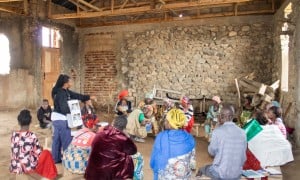
The project aims to help vulnerable households recover from shocks and re-establish their livelihoods. As part of the Income Generating Activities (IGAs), the project is providing vocational, entrepreneurship and literacy training as well as support for the establishment and growth of IGAs, including monthly transfers and start-up kits for their small businesses and development of business plans.
For the Cash for Work component, communities are taking part in manual work to rehabilitate community assets, such as roads, market sheds and community halls as a form of temporary employment. These activities provide an important income supplement to cover immediate needs and play a central role in the acceptance of the project within the communities. Establishing and supporting Village Savings and Loans Associations (VSLAs) is improving access to local financial services and encourage the regular collection of savings, their safe storage and potential use to support loans to members. This community-based approach improves the ability of individuals and the community to absorb future shocks.
Improve household nutrition, child and maternal health
Protecting vulnerable households
Inclusive programming


Results
Working across 4 sectors to create a sustainable and resilient environment in which vulnerable households benefit, thereby reducing the suffering of men, women and children and supporting those affected by humanitarian crises, between December 2023 and December 2025, EAST achieved the following:
- 123,928 people were reached with new livelihood development and/or recovery activities
- 9,353 Income Generating Activities (IGAs) were launched or supported and 14,339 people received entrepreneurial training.
- 8,669 children under 5 were admitted for the treatment of severe acute malnutrition.
- 19 health centres benefitted from the construction/rehabilitation of WASH infrastructures.
- 3,084 people recieved psychosocial support.
- 1,200 community leaders participated in conflict management workshops.

Focus on climate-sensitive programming and social cohesion in the DRC
The adoption of inclusive livelihood practices, which ensure equitable economic opportunities for all members of the community, can significantly strengthen individual capacities and social cohesion. By creating an environment where everyone has access to resources and opportunities, these practices can foster trust, reduce social tensions and encourage collaboration, thereby promoting a more resilient and harmonious society.
As part of the EAST programme, research on climate-sensitive programming was conducted to analyse how and to what extent inclusive and climate-sensitive livelihood practices adopted in communities served by EAST consortium partners in eastern DRC contribute to social cohesion or influence conflict dynamics. The research questions, providing evidence of the positive impact of EAST on the targeted communities and in particular demonstrating that the adoption and development of climate-resilient livelihoods in the localities covered by the programme, contribute significantly to conflict mitigation and social cohesion.
Testimonials
Overcoming Malnutrition with the Right Care
After her parents divorced, 2-year-old Kitenge was placed in the care of her paternal aunt. In this household, she experienced abuse, including being denied food, which led to severe acute malnutrition with multiple complications. Today, she lives with Joséphine, a social worker from the Division of Social Affairs (DIVAS) in Nyunzu, and is receiving appropriate care at the Tchanga Tchanga health centre, supported by Concern as part of the EAST programme. Joséphine explains:“This child was a victim of abuse. She was found at night by patrol officers, sleeping on the roadside, because her aunt had placed her in a room with livestock (goats). That’s how she was entrusted to me. Her health was very poor, and I had no means to take care of her — I was desperate. That’s when I learned that free healthcare was available at the Tchanga-Tchanga health centre. When I took her there, the doctors immediately recognised her, as she had suddenly disappeared from treatment three weeks earlier.”
According to her adoptive mother and the treating doctor, Kitenge’s parents had taken her to a traditional healer to rid her of witchcraft. In the local culture, it is common for children suffering from malaria or malnutrition to be taken to healers, which can delay proper medical diagnosis. Within the framework of the EAST programme, Concern’s health and nutrition teams raise awareness among and train traditional practitioners in the intervention areas to strengthen referral systems and collaboration between health facilities and traditional healers.
Today, with regular follow-up and nutritional support, Kitenge is gradually regaining her health. “I hope she fully recovers. I would like her to become a doctor one day, because it is thanks to doctors that she will regain a normal life,” says Joséphine.


Strengthening Local Resilience by Rehabilitating Water Access Roads through Cash for Work
Maria lives in Tutuba, a village located nearly 15km from Nyunzu. She is one of the participants in the EAST programmme's 'Cash for Work' scheme. This scheme enables highlyvulnerable community members to actively participate in work that benefits everyone. In return for their engagement, participants receive cash payments, allowing them to cover their essential needs independently and with dignity. This approach combines immediate assistance with long-term value, improving both community living conditions and individual capacities.
The work Maria was involved in included rehabilitating a 3km road leading to a drinking water source built a few years ago by Concern. Women were the ones who regularly walked this distance to collect water. The rehabilitation has made the path safer and improved access to this water source. The road is now passable on foot, by bicycle, or by motorcycle, and the increased traffic has made it less isolated and more secure.
“It used to be very difficult to reach the water source here. This road was dangerous for us women because there was a risk of assault. Today, thanks to our work, we feel much safer. We worked without discrimination, and at the end, we received a cash transfer. This money helped us pay for the children’s school fees andother basic needs. With the little that was left, I bought ducks and chickens to start my livestock farming activity.”
Despite the significant improvement in access to this water source, the distance remains the same, and Maria is advocating for the installation of a borehole in the centre of the village to reduce this.


Holistic Support for GBV Survivors
Matulizo*, a mother of 4, survived GBV and was abandoned by her husband, enlisted in a local armed group for several years. After being sexually assaulted by armed men, she received medical care through the EAST programme and now takes part in a support programme for survivors in Masisi territory.
“Since my husband left three years ago, I survived by working for others. My children and Ihad neither food nor money. That’s why I decided to go to Kihanga to work the fields in exchange for a small payment. On my way back, I was confronted by armed men who raped me,” recounts Matulizo.
Matulizo went straight to the health centre supported by PUI: “I arrived here within 72 hours** as taught in the Concern awareness sessions in my village. I was received by the medical staff, who took care of me. The Première Urgence team referred me to the Concern staff, who provided me with individual protection support that continues to help me.”
Concern offers survivors of gender-based violence the opportunity to take part in livelihood training to strengthen their resilience. As part of this programme, Matulizo is participating in vocational training that will enable her to start her own income-generating activity. At the end of the training, she will receive a cash transfer to launch her project. Matulizo explains:“With the training I am receiving now, I hope to receive my cash transfer and start a business. This thought continues to lift my spirits, and I hope for a better life, because after my assault, I had lost the will to live; I was angry and desperate. My hope is to one day buy a plot of land and build my own house, because now I live in a makeshift shelter.”
Like Matulizo, many women and girls face the risk of sexual assault when going to the fields, amid persistent insecurity. Available data indicate that 95% of gender-based sexual violence allegations in the DRC involve rape. In a context where local support services are limited, access to appropriate medical and holistic care remains a priority.
*The name has been changed for security reasons
** Survivors of sexual violence should receive care within 72 hours of the incident to maximise the effectiveness of treatment, prevent sexually transmitted infections, and reduce the risk of unintended pregnancies.
From Displacement to Recovery
In 2019, Maria, a mother of 10, lost everything when her village of Kabutonga was attacked and destroyed. With only what they could carry, her family walked 30 kilometres to Kabimba and tried to survive by working other people’s fields for small payments and a place to sleep. When calm returned, they made the journey back home, to a village that needed to be rebuilt and a life that had to begin again from scratch.
“In Kabimba, all we could do was cultivate and farm for other people who paid us and gave us a place to sleep,” Maria says. “When we heard peace had been restored, we returned, this is the place we were used to, but we were suffering. At home I farm and my husband makes charcoal. If he produces 3 sacks, he can earn about 100,000 CDF (around £30) every two weeks to provide food and pay school fees. But when we first returned, our children missed a full year of school because we didn’t have the means.”
A turning point came when Maria was selected for Concern Worldwide’s livelihoods programme. She received peanut (groundnut), bean and maize seeds to begin cultivating again, along with basic items such as cooking oil, beans, flour and salt to help the family through. Maria also joined a Concern-supported village savings and loan association (VSLA) and received cash support to cover essential food costs while attending training. “After receiving this assistance, I had food, money and something to work at. With it, I can pay school fees, hire casual farm workers when needed, and cover healthcare for my children.” Maria adds that when more families have seeds to plant, farms are less likely to be targeted and theft reduces. Her goal now is to improve her groundnut production, sell at market in Kalemie, and break free from poverty.

VSLA's and Vocational Training
Paul, father of 8 children, lives in Luchebere, Masisi territory, with his 2 grandchildren. He was forced to flee his village several times due to recent armed clashes in the region. After a month-long displacement in Katale, where he lived in difficult conditions with very limited resources, Paule decided to return to Luchebere. He recounts: “I fled the war in the 1990s, during the time of Nyamaboko 1, and found safety here. Recently, I was forced to leave Luchebere to seek refuge in Katale. I spent a month there, but life was very difficult for my family and me, and the clashes followed us. We had to beg to survive, which is why I decided to return to Luchebere.”
Upon his return, Paul joined the EAST programme, implemented by Concern and its partners in Masisi territory. “For the past few months, I have been taking part in a VSLA, which allows me to borrow money when needed. I first borrowed 100,000 Congolese francs ($34) to start a small business buying and selling chickens. Then, with a second loan, I bought a field where I have planted beans that I will be able to harvest soon,” he explains.
As part of the programme, Paul is currently taking vocational training in pig farming. With the income he generates, he plans to restart his livestock activities. “I was a livestock farmer before, but I lost everything during the armed conflicts. I had to start from scratch. Participating in this programme helps me take care of my family. Today, my children can go to school, eat properly, and wear uniforms,” he recounts.
Paul has new hopes for the future: “In 3 years, if all goes well, I will be able to buy a cow and restart my livestock business. Concern has also taught me to believe in myself. Today, I have confidence in the future and in my ability to grow my business.”

 Report
 Blog
Blog