
Knowledge Hub
 Blog
BlogStories of Inspiration: Humanitarian Programming in Yemen
More than a decade of war and conflict has escalated civilian suffering in Yemen, forcing people into unsustainable living conditions largely dependent on humanitarian intervention. A combination of climate shocks, displacement, and a worsening economic crisis have complicated matters, preventing access to essential services and exhausting community resources.
Concern is working to meet humanitarian needs in Yemen with programmes focusing on WASH, health and nutrition, and emergency response.
Environmentally sustainable access to water
Yemen is one of the world’s most water-scarce countries, where more than 40 per cent of the population lack access to sufficient drinking water. In Ta’iz governorate, water needs have significantly increased due to the destruction of infrastructure, large-scale displacements, inadequate water resource management and the impact of climate change. In rural areas without electricity, water sources run on diesel generators and households rely on water trucking, which are not environmentally or financially sustainable.
Concern, in partnership with the local NGO Generation without Qat (GWQ), rehabilitated the Alhamili water project in Mawza’ district, Ta’iz governorate. Mohamed Alaswadi, the Programme Coordinator from GWQ, explains: “The people in Mawza’ district face high levels of malnutrition and disease outbreaks. One of the key drivers of these issues is the lack of safe water due to damaged or contaminated water sources. Jointly with Concern and the local authorities, we’ve worked on the Alhamili water project, which is now serving over 1,600 people with safe water.”
Before this project, people in the area were using unprotected water sources with limited water to meet their basic needs. Traditionally, women and girls take responsibility for collecting water for household needs, and they had to travel long distances to collect water
The women and children were doing all the hard work to collect water with risk of falling into the unprotected deep wells. Children missed school as the first thing they do in the morning is to travel long distances to bring water for the family. This project was essential and eased our suffering.

Before initiating the rehabilitation work on the water project, water tests were conducted to ensure the implementation of necessary mitigation measures and to provide safe water for the affected communities. The rehabilitation work included the repair of a well, as well as the installation of a solar energy system, water distribution networks and four 3,000 litre-capacity water tanks.
Bless you all for solving our main problem. The communities are already struggling with many crises, and we cannot afford the high cost of water trucking or fuel to run the generator for pumping water from the well. With this solar water system, the communities can now access enough water near their homes.
With the construction of the Alhamili water project, the people in the target areas now have equitable access to safe water, contributing to Sustainable Development Goal (SDGs), Goal 6: Clean Water and Sanitation and Goal 3: Good Health and Well-Being. Another local health partner, who is supporting health services in the target area, connected a water supply line from Alhamili's water source to the health facility, providing access to safe water for the routine operation of the facility and contributing to improved quality of care at the health facility.

Recovery from Severe Acute Malnutrition (SAM)
Fatima* is living in a displacement camp in the Lahj Governorate. The family has been displaced for over seven years now. Fatima’s mother is a housewife, and her father is a daily worker. The family struggles to meet their basic needs due to the deteriorating economic situation and the recent reduction in humanitarian aid. Malnutrition and disease outbreaks are among the pressing challenges. The health clinic, supported by Concern in the camp, serves as a lifeline for many in the camp and the local population, providing them with free healthcare during these challenging times.
Fatima’s mother told me that her young child is not feeling well, she is not gaining weight, lacks energy, and she is worried about Fatima’s health. I did the nutrition screening and found that she is suffering from severe malnutrition.

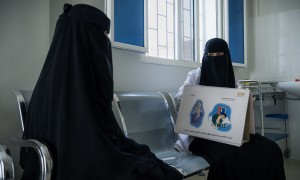
Basma is one of the trained CHVs supported by Concern. Her role is vital in bridging the gap between communities and healthcare facilities. Basma provided basic psychosocial support and nutrition counselling to Fatima’s mother, advised her to visit the nearest health clinic supported by Concern. Fatima was admitted to the nutrition programme after necessary health and nutrition checkups by the doctor and nutrition workers at the clinic.
Fatima received the routine supply of Ready-to-Use Therapeutic Food (RUTF) from the health clinic. Basma conducted routine visits to Fatima, provided one-to-one nutrition counselling to the mother, and monitored growth through regular nutrition screening and observations. Fatima also received routine check-ups from the medical staff and received vaccinations according to the immunisation schedule.
Fatima's mother was worried about her recovery because of the poor living conditions in the camp, risk of cholera, and inadequate access to food, but she always listened to our counselling sessions and never missed any follow-up visits to the clinic, and she understood the importance of nutrition supplies, breastfeeding and good hygiene, allowing Fatima to recover fully.
Fatima's mother was happy with the support and care she received from the clinic and prayed for Basma, who helped her with timely referrals to the health clinic. Fatima’s mother said, “We are already struggling with many challenges but Concern is providing free medicines and food (nutrition supplement) for our children and pregnant women. Many children will die and suffer from disease if there is no clinic. The people here cannot afford to go to the city for treatment, and they cannot buy medicines.”
Due to recent funding cuts, over 2,000 therapeutic feeding programmes have been closed in Yemen, increasing the risk of malnutrition and preventable deaths, especially for young children. According to a UNICEF report, 55% of children under five in Yemen suffer from chronic malnutrition; these conditions are life-threatening for children and are entirely preventable.

 Learning Paper