
Knowledge Hub


“We thought we were leaving for a week, but we came back nine months later. The house had no roof, the windows and doors were smashed, and everything was looted,” recalls Maryna
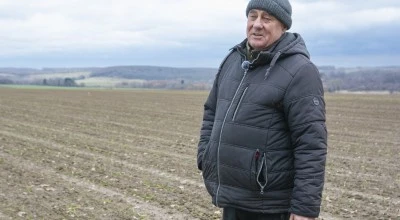
Maryna is from the village of Bila Krynytsia in Ukraine and before the conflict in Ukraine escalated to nationwide levels in 2022, she had been making her living through vegetable farming. Her farm had one and a half hectares of leased land, where she’d grow cabbage, peppers, tomatoes and greens to sell at nearby village markets.
When the war began, her village soon found itself on the “zero line” and faced constant shelling that forced the family to evacuate and leave everything behind.

When Maryna and her family first fled their home, they thought they would only be leaving for a week, but unfortunately, they weren’t able to return for nine months. When they did return, they found everything was looted.
“The house had no roof, the windows and doors were smashed, and everything was looted—from household appliances to personal belongings. A new tractor we bought in 2021 was gone. The irrigation system was burned, and the motors and filters were stolen,” Maryna says.
They also found that seeds worth around $2,500 USD (100,000 Ukrainian Hryvnias) were gone and other farming equipment was irreparably burned. In fact, the only equipment left was an old Sprinter van—and only because they had driven it out when evacuating.
The past two years have seen a rise in bloodshed for civilians in Ukraine, with more than 2,500 casualties and 12,000 injuries, particularly in the regions bordering Russia. After four years of nationwide conflict in Ukraine, an estimated 10.8 million Ukrainians require humanitarian assistance. That is nearly 1 out of every 3 Ukrainians. Plus, wider consequences of the conflict are also grinding people’s standard of living to a halt, with inflation skyrocketing and household income freefalling, leaving families succumbing to debt and enduring a jagged cost of living crisis.

Another Ukrainian, Nataliia, also relayed how conflict had changed her life. Ten years ago, Nataliia launched a soap making business, inspired by her own experiences with dealing with skin issues that required natural alternatives to store-bought products. Nataliia took a hands-on approach to her business which meant making her soap at home, in her kitchen, mostly in her free time, at night when no one could disturb her. She notes that she was often surrounded by boxes of materials and as a small family run business, she had to improvise, repairing any broken equipment herself and using simple film and tape for the packaging. Despite these challenges by 2019, Nataliia’s tenacity resulted in her building a business that grew from a side-hustle targeting local customers to eventually expanding to a nationwide market.
However, conflict upended her life and business. Her home was located right next to the front line and was damaged by a shell from a tank that hit a neighbour’s house but also destroyed part of her home. Her roof, windows, doors and fence were all damaged, leading Nataliia and her family to seek safety in their basement. In June 2022, she had to flee with her two children, while her husband stayed behind due to his job and elderly parents. “I held out as long as I could, but after a heavy shelling, I decided I could no longer risk the children’s lives,” Nataliia says.
Her livelihood was devastated. As people fled, there were fewer clients, but then people’s incomes also fell, leaving orders scarce. Not to mention, the severe damage to the country’s infrastructure made sending parcels difficult.
Going beyond livelihoods, the mental health of Ukrainians is also being severely affected by the conflict. An assessment by the World Health Organisation found that 68% of Ukrainians reported a decline in their general health compared to before the countrywide invasion in 2022, with 46% of people specifically mentioning being affected by mental health concerns. Across the country, internally displaced people report the highest levels of depression and alongside blows to their mental health, they also struggle with insecure housing, high unemployment rates and are more likely to rely upon social assistance.

How Concern’s work in Ukraine is leading to recovery
Concern Worldwide has been in Ukraine since 2022, working on a multi-sector emergency response that covers supporting recovery for Ukrainians impacted by the conflict. As part of our coordinated response delivered through our partners the Joint Emergency Response in Ukraine (JERU) and Irish Aid, Concern provides Ukrainians with cash grants that allow families to prioritise individual needs while supporting local economies, psychosocial support to help people deal with the emotional toll of the conflict and supplying useful kits such as heating and hygiene items for those in need.
Last year, Concern reached over 114,000 people, primarily in the border regions most heavily battered by conflict. Both Maryna and Nataliia have started rebuilding their livelihoods with help from Concern Worldwide.
When Maryna returned to her family farm, for three days, she simply walked around the devastated yard in despair. That first month after they came back home was the hardest month for them. During the night, her and her husband stayed at her parents’ home 15 km away and in the daytime, they’d clear the debris on the farm and try to restore it as best they could.
Restoring their farm seemed like an insurmountable task at the start, however, thanks to a grant from Concern, Maryna was able to purchase a cabbage shredder and a generator, so she can work even at village markets where there is no electricity.
“This adds value to our product, my husband and I thought. And why not? If someone buys a sack of cabbage for the winter, we shred it right away, pack it in bags, and at home you only need to mix it with salt. Very convenient,” says Maryna.
Nataliia too, was able to restore her livelihood through the grant. After receiving around $1,200, Nataliia was able to establish her own workshop in an extension of her house and purchase professional equipment: a planetary mixer, dehydrator, heat sealer for packaging, and storage and packing furniture.
“Without the grant, it would have been hard to buy all this. I definitely couldn’t have spared 50,000 UAH (approx. 1,200 USD). For example, my husband and I did the repairs in the workshop ourselves. And we bought the equipment with this first grant. Now I can even show people the production process,” Nataliia says.
The grant has also allowed her to upgrade her business to target customers on social media and return to her seasonal rhythm despite all the challenges that conflict brings. “Turnover is increasing, there’s money for social media advertising, and gradually the number of clients from different parts of the country is growing,” she says.
Amid these challenging circumstances, Concern Worldwide remains committed to providing an emergency response that can save lives, but then eventually transition to rebuilding the livelihoods and restoring hope to people like Maryna and Nataliia.