




Knowledge Hub
Urgent action is needed at COP31 to deliver climate funding commitments

Global leaders must act urgently at COP31 to ensure that funding committed in 2024 to help lower income countries adapt to the growing impact of climate change, begins to flow.
“The impact of climate change on some of the world’s poorest countries is escalating, with devastating consequences,” Concern Worldwide’s Global Advocacy Advisor for Climate Resilience, Laura Bahlman, said. “Climate adaptation funding is urgently needed as countries work to protect vulnerable communities. We are facing a race against the clock. At COP31 we need to see world leaders shift from funding commitments to funding delivery.
At COP29 in 2024 a commitment was made to increase finance to developing countries to at least US$300 billion annually by 2035, alongside efforts to mobilise US$1.3 trillion per year through an expanded contributor base and a wider range of financing sources (e.g. private sector). Last year at COP30 there was another commitment to tripling adaptation funding by 2035.
“We need a timeline for delivering this funding,” Ms Bahlman said. “We also need to see clarity regarding how these commitments are going to be implemented and to ensure access for those at the frontlines of climate change.”
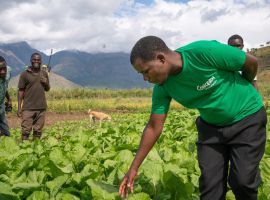
Climate adaptation finance is used to fund a diverse range of programmes, from climate-smart agriculture practices and rainwater harvesting, to flood protection measures and early warning systems. They help communities build their resilience in the face of increasingly frequent impacts of climate events.
Fragile and conflict-affected countries
Increased funding is just part of the solution. “The international climate finance system must be capable of working across the full range of contexts in which people experience climate vulnerability, including millions of people living in countries which are fragile and conflict-affected,” she said.
Fragile and conflict-affected countries are home to almost one billion people facing severe challenges, including weak institutions, limited public services, extreme poverty, forced displacement, and conflict. Climate change is a threat multiplier of conflict and increasing levels of fragility.
Such countries receive lower levels of adaptation finance per head compared to Small Island Developing States (SIDS) and Least Developed Countries (LDCs). On average fragile countries have received only about two-thirds the level of per capita adaptation finance in comparison to LDCs, and only about one-third the level of SIDS between 2016-2023.
Across the Horn of Africa, drought, conflict, displacement, and economic instability are combining to push millions of people into increasingly precarious situations. More than 37 million people across six countries in the region are experiencing, or are projected to experience, acute food insecurity, with over 4.9 million children projected to suffer acute malnutrition. Yet these are the contexts where conventional climate finance is often hardest to access.
At COP31, we want to see greater recognition of the specific barriers facing fragile and conflict-affected states, alongside progress towards needs-based financing approaches that enable countries most affected to access adaptation finance.
Locally led action
Adaptation funding commitments must also translate into locally led action and implementation. Countries need the resources, capacity, and technical support to deliver their National Adaptation Plans, and translate these into action at national and local levels.
“It’s vital that adaptation action reflects local realities,” Ms Bahlman said. “Communities need the resources and decision-making power to shape and lead their own adaptation priorities. The recent floods in Nepal and Bangladesh demonstrate how quickly communities can lose homes, livelihoods, access to essential services. Recovery cannot simply mean rebuilding what was lost. It must also mean addressing the vulnerabilities that leave communities exposed to repeated shocks.”


